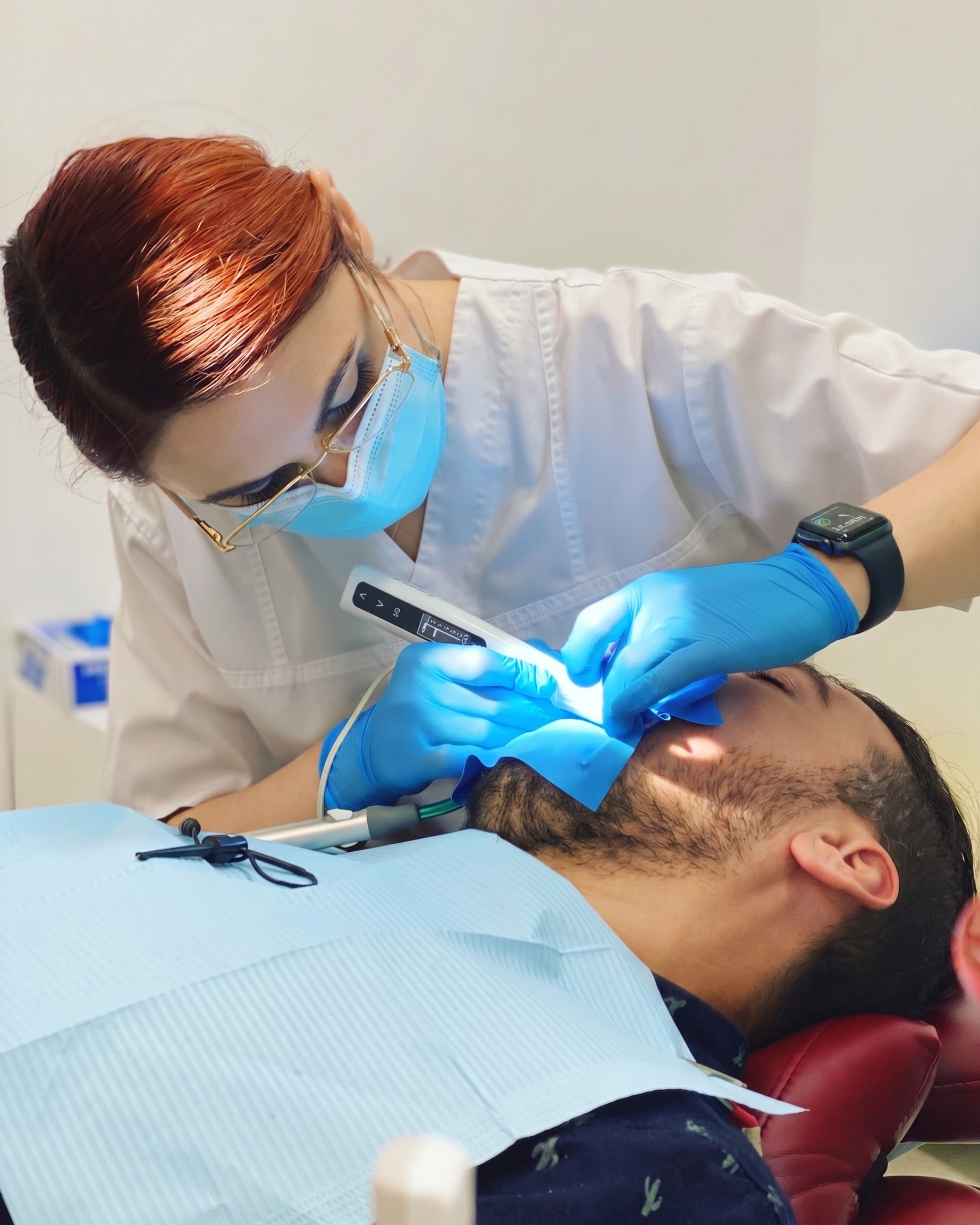
Laser Dental Treatments
Dental Laser
- Treatment indication
- Applying the laser
- Healing
Indicative pricing
Price overview
Prices are indicative. I set the final price at the consultation, after examining you and once we know how many teeth are involved and what preparation each one calls for.
Questions about dental laser
A message, ready for you
What would be useful for you to know about laser?
Select everything that applies.
Why this treatment
Benefits
- Precise incisions in soft tissue, with reduced impact on the neighbouring structures
- Reduced bleeding during the procedure and, as a rule, fewer sutures
- Useful in small-scale gingival surgery and in gum contouring
- In periodontal therapy it remains an adjunct, alongside scaling and root planing
Step by step
How it works
Treatment indication
Applying the laser
Healing
Treatment process
Method in 3 steps
Step 1
3D intraoral scan
Step 2
Digital treatment planning
Step 3
Execution & cementation
Frequently asked
What patients ask me
The duration depends on the complexity of the case. A crown or a veneer usually takes 2-3 appointments over 1-2 weeks: one for the preparation and the impression, then one or two for the try-in and the cementation. Implant-supported work follows osseointegration, the time in which bone grows in direct contact with the implant surface, and can take 3-6 months. Between the stages you usually wear a temporary solution, so that you are not left with a gap. At the initial consultation I give you a timeline that fits your own case, so that you know from the start what to expect.
I use pressed ceramic and CAD/CAM-milled zirconia, both metal-free, biocompatible and chosen so that they blend in colour with the natural teeth. Pressed ceramic lets light through in a way similar to enamel, which is why it is often used at the front of the mouth; zirconia is more opaque, but it stands up better to the chewing forces at the back. The choice of material depends on the position of the tooth, on the space available and on the aesthetic goals we set together.
There is no fixed number of years for how long a restoration will last, and it cannot be promised at the start of treatment. It depends on daily oral hygiene, your bite (occlusion), and any parafunctional habits (bruxism places extra load on any restoration), the condition of the supporting periodontium, and how regularly you attend check-ups. Zirconia crowns, pressed-ceramic veneers, and an integrated implant are built to last, but they remain maintenance-dependent and may in time need repair or replacement. At check-ups we examine the margins of the restoration, the bite, and the surrounding gum tissue, precisely so we can act early, before a problem becomes symptomatic.
I design the restoration from a digital impression and detailed treatment planning, so that it fits precisely to your bite and to the aesthetics. An adjustment period of a few days is normal: the tongue seeks out the new shape, and getting used to it comes gradually, as you go back to eating and speaking as usual. If some discomfort remains, or a point that bothers you when you bite, tell me: I assess it and adjust it at the follow-up appointment.
Brushing twice a day with a soft toothbrush, cleaning between the teeth (dental floss or interproximal brushes) and avoiding hard foods that can fracture ceramic are the key steps. What matters most is the margin between the restoration and the gum, where plaque settles most easily. Implant crowns benefit from a water flosser for cleaning around the abutment, because the tissue around an implant becomes inflamed more readily than the tissue around a natural tooth. After every procedure I show you, on your own restoration, how to clean it, step by step.
I check the prosthetic work at every stage, from the choice of material to the final fit. I recommend a professional maintenance check every 6-12 months, to assess the restorations and your overall oral health. At a check-up of that kind I look at the margins, the contact points with the neighbouring teeth, the way the bite closes and the condition of the surrounding gum, and the professional cleaning reaches the places a toothbrush does not. When the restoration is handed over, I explain unhurriedly how it is looked after, and we go over it again if anything is still unclear.